


How Open works: Inspire – Act – Share
Most transformation programmes begin with a launch.
There is a strategy presentation. A clear roadmap. A set of well-designed slides explaining where the organisation is heading and why. The message is shared broadly, leaders are briefed, and the initiative officially begins.
That moment matters. But anyone who has worked with change knows one thing for sure. The launch is only the starting point.
Because change does not happen when it is announced. It happens over time. It happens when people begin to understand what is changing, try it in their day-to-day work, and slowly make it part of how they operate.
After working with transformations across organisations, industries and cultures, we noticed a clear pattern. When change succeeds, it tends to move through the same progression.
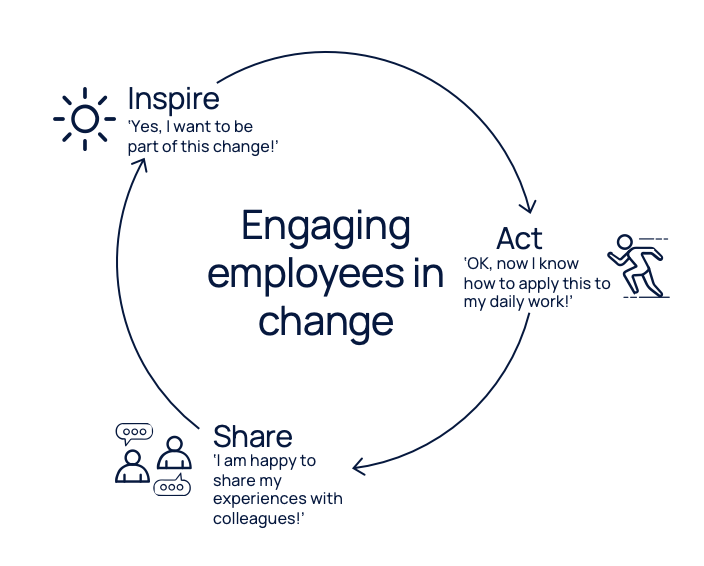
People first need to understand the change. Then they need support to act on it. And finally, they need to see it lived and shared by others.
This insight became the foundation of the framework we use at Open: Inspire – Act – Share.
We have worked with this model for more than a decade to help organisations move beyond launching change and toward making it stick.
Inspire: Create clarity and direction
Before people change how they work, they need clarity.
Why are we doing this? What problem are we trying to solve? What will be different, and what will stay the same? What does success look like in practice?
Inspire is not about slogans, vision posters or one-off storytelling. It is about helping people understand the direction and see how it connects to their role, their team and the bigger picture.
For example, when introducing a new digital platform, inspiration is not just saying “we are becoming more digital”. It is explaining what is broken today, how the new setup will make work easier, and what it enables for customers and employees.
When people understand the why and the direction, resistance drops and curiosity increases.
Act: Make change workable in everyday life
Understanding alone is not enough. Change only becomes real when people start doing things differently.
This is where Act comes in.
In the Act phase, employees begin working with new tools, processes or behaviours. Leaders support their teams as they try, learn and adjust. Communication becomes practical, concrete and close to everyday work.
That might mean:
Clear guidance on how a new process works in practice
Training that fits into busy schedules
Managers being equipped to answer questions and handle uncertainty
Space to test, fail and learn so people gain confidence
For instance, rolling out Copilot or new AI tools is not just a technical exercise. People need hands-on examples relevant to their role, clear boundaries for use, and reassurance that it is safe to explore.
When organisations skip this phase or rush it, change stays theoretical. When they invest in it, people begin to feel capable, not just informed.
Share: Build momentum through real experiences
The final phase is Share, and this is where transformation truly gains momentum.
When people start sharing experiences, tips and small wins, adoption spreads organically. What felt new and uncertain begins to feel normal. Peers become the strongest drivers of change.
Sharing does not have to be polished success stories. Often, the most powerful examples are simple and honest:
A team explaining how they saved time using a new tool
A manager sharing what did not work and what they learned
Employees helping each other across teams
This phase turns change from “the programme” into “how we work around here”.
Why Inspire – Act – Share works
The strength of Inspire – Act – Share lies in its simplicity.
Change is not a single announcement or milestone. It is a journey from understanding, to action, to shared ownership.
At Open, we design communication, engagement and experiences that support each stage of that journey. We work across leadership, HR, IT and communications to ensure change is not only introduced, but embedded.
Because when people understand the direction, feel confident acting on it, and see others doing the same, transformation stops feeling temporary.
It becomes part of how the organisation moves forward.